SEO vs AEO vs GEO: Understanding Your Business Visibility Needs
Understanding the differences between Search Engine Optimization (SEO), AI Engine Optimization (AEO), and Geospatial Engine Optimization (GEO) is crucial for small and medium businesses looking to thrive in an increasingly complex digital landscape, especially with the rise of
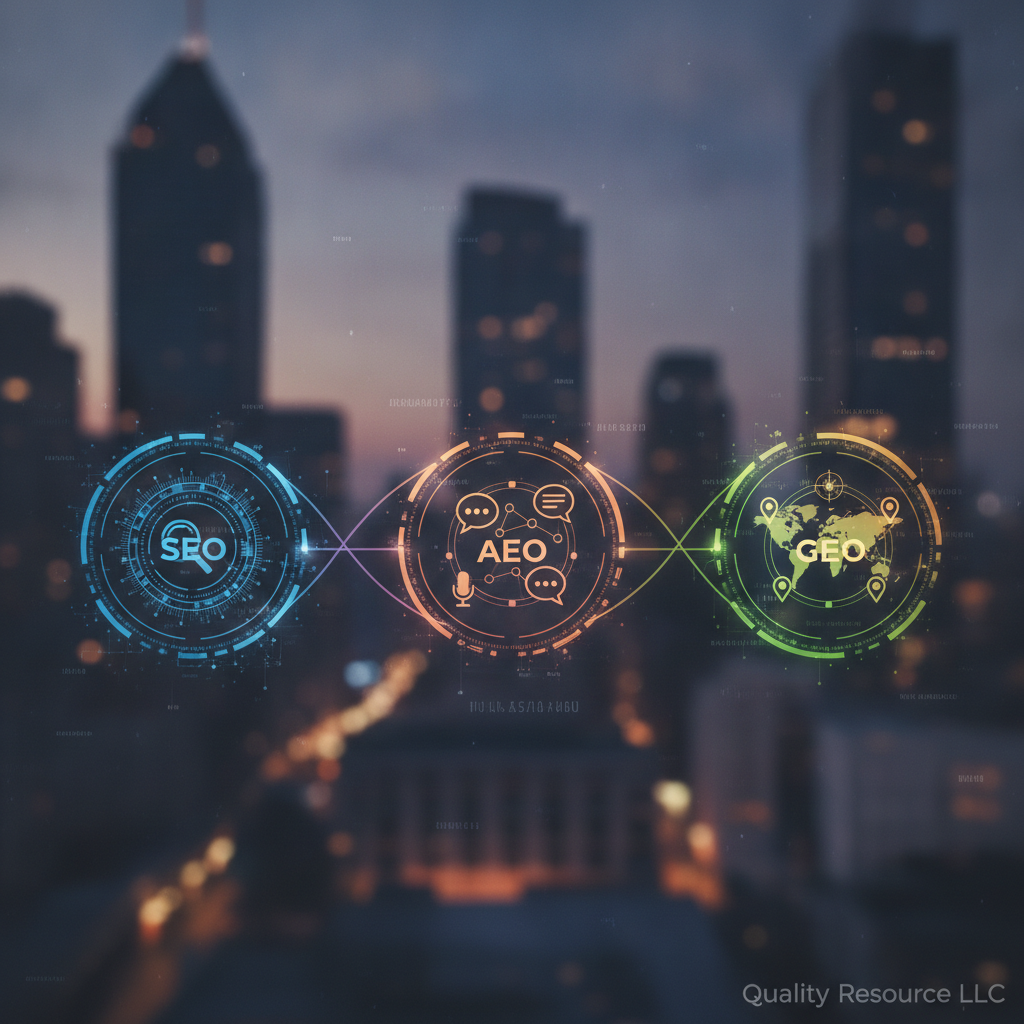
In today's fast-evolving digital world, getting your business found online is more complex than ever. You've likely heard of SEO, but what about AEO and GEO? These three acronyms represent distinct yet interconnected strategies for online visibility. SEO focuses on search engine rankings, AEO targets AI answer engines and voice search, and GEO specializes in local online visibility, with the best strategy for your business depending on your customer base and how they find you. For small and medium businesses (SMBs), understanding these differences is key to making informed decisions about where to invest your marketing efforts and truly compete like a larger enterprise.
The goal isn't just to appear online; it's to appear where your ideal customers are looking, whether that's through a traditional search query, a conversational AI assistant, or a map app while they're on the go. This guide breaks down each strategy, explores their unique benefits and challenges, and helps you determine which combination is right for your business.
Table of Contents
- SEO, AEO, and GEO: At a Glance
- What is Search Engine Optimization (SEO)?
- What is AI Engine Optimization (AEO)?
- What is Geospatial Engine Optimization (GEO)?
- How SEO, AEO, and GEO Work Together for Business Growth
- Which Strategy Do You Need? A Decision Guide
- Getting Started with Your Visibility Strategy
- Frequently Asked Questions
- The Future of Business Visibility
SEO, AEO, and GEO: At a Glance
Before diving deep into each, here's a quick overview of how SEO, AEO, and GEO compare across key aspects. This table illustrates their primary focus, goals, and the types of businesses that benefit most from each.
| Criteria | SEO (Search Engine Optimization) | AEO (AI Engine Optimization) | GEO (Geospatial Engine Optimization) |
|---|---|---|---|
| Primary Focus | Ranking high on traditional search engine results pages (SERPs) like Google, Bing. | Optimizing for conversational AI answer engines (ChatGPT, Google AI Overviews) and voice assistants (Siri, Alexa). | Improving visibility in location-based searches, maps, and local directories. |
| Main Goal | Drive organic traffic to your website through relevant keywords and authority. | Become the definitive, direct answer to user queries, often verbally or as a concise summary. | Attract local customers, drive foot traffic, and increase localized online engagement. |
| Key Tactics | Keyword research, on-page optimization, technical SEO, link building, content creation. | Schema markup, natural language processing, FAQ content, answer-first formatting, clear factual answers. | Google Business Profile optimization, local citations, local keyword targeting, reviews management, localized content. |
| Measurement | Website traffic, keyword rankings, conversion rates, bounce rate. | Direct answer appearances, citation frequency in AI responses, voice search traffic. | Local pack rankings, Google Maps visibility, local reviews, calls, directions requests. |
| Best For | Businesses needing broad online reach, information dissemination, and lead generation via website. | Businesses with easily answerable questions, seeking authoritative positions, or targeting voice search users. | Businesses with a physical location, service areas, or primarily local customer bases. |
What is Search Engine Optimization (SEO)?
Search Engine Optimization (SEO) is the practice of increasing the quantity and quality of traffic to your website through organic (non-paid) search engine results. It involves a suite of strategies and techniques designed to improve your website's visibility when people search for products or services related to your business on search engines like Google or Bing. At its core, SEO is about making your website easy for both users and search engine crawlers to understand, ensuring that your content is relevant and valuable for specific search queries.
The goal is to rank higher on the Search Engine Results Page (SERP), ideally on the first page, because most users don't look beyond the initial results. For a small business, a strong SEO strategy can level the playing field, helping you attract customers who are actively looking for what you offer, often with a clear intent to purchase or learn. This direct connection to user intent makes SEO a powerful tool for sustainable growth.
Strengths of SEO for Small Businesses
- Cost-Effective Lead Generation: Unlike paid advertising, organic traffic from SEO doesn't cost money per click. Once your content ranks, it can continue to bring in visitors over time without ongoing ad spend.
- Increased Credibility and Trust: Websites that rank highly on search engines are often perceived as more credible and authoritative by users. This builds trust with potential customers.
- Sustainable Growth: A well-executed SEO strategy provides long-term results, building an asset in your website's authority and visibility that compounds over time. You can learn more about its lasting impact here: Why SEO Matters for Your Small Business in Today's Digital World.
- Broader Reach: SEO can help you reach a wider audience beyond your immediate local vicinity, appealing to customers searching for services or products you offer regionally or nationally.
Weaknesses and Challenges of SEO
- Time-Consuming: SEO is not an overnight solution. It requires ongoing effort, patience, and consistent content creation to see significant results.
- Algorithm Changes: Search engine algorithms are constantly updated, requiring businesses to stay informed and adapt their strategies to maintain rankings.
- High Competition: Depending on your industry, competition for top keywords can be intense, making it challenging for new businesses to break through.
- Technical Complexity: Effective SEO often requires a good understanding of technical aspects like website structure, page speed, and mobile responsiveness.
Best Fit for SEO
SEO is ideal for almost any business that has a website and aims to attract customers beyond immediate local searches, share information, or generate leads through online content. This includes e-commerce stores, information-based businesses, service providers looking for regional clients, and businesses that want to establish long-term online authority and brand recognition. For example, an online boutique selling custom jewelry nationwide would heavily rely on SEO to reach potential customers searching for unique pieces.
What is AI Engine Optimization (AEO)?
AI Engine Optimization (AEO) is a newer discipline focused on optimizing your online content to be understood and used by AI-powered search engines, conversational AI assistants, and voice search devices. Unlike traditional SEO, which aims for a link on a search results page, AEO strives for your business or information to be the direct, concise answer provided by AI models like ChatGPT, Google AI Overviews, or voice assistants like Siri and Alexa. This is critical as more users interact with AI for quick answers or to complete tasks.
AEO recognizes that AI models process information differently. They look for clear, factual, well-structured content that directly answers questions rather than just keyword density. The rise of AI means that businesses need to think about not just *how* they rank, but *how* they are synthesized, summarized, and recommended by these intelligent systems. This often involves creating what Quality Resource LLC calls an agent-ready website, designed to be easily digestible and actionable for AI agents and conversational interfaces.
Pro tip: With AI answer engines, the goal is often to be the single best answer, not one of ten links. Structure your content with clear question-and-answer formats.
Strengths of AEO for Small Businesses
- Direct Answers and Recommendations: Being the source for an AI's answer can lead to direct recommendations or even transactions initiated by the AI itself, bypassing traditional search results. You can learn more here: How to Get Your Business Recommended by ChatGPT: A Practical Guide.
- Voice Search Advantage: AEO is intrinsically linked to voice search, as AI assistants are the primary interface. Optimizing for AEO helps capture this growing segment of queries.
- Increased Authority and Trust: When an AI system cites your business as the definitive answer, it significantly boosts your perceived authority and trustworthiness.
- Future-Proofing: As AI technology advances, AEO strategies position your business to thrive in a search landscape increasingly dominated by intelligent systems.
Weaknesses and Challenges of AEO
- Evolving Algorithms: AI models are constantly being updated and refined, making AEO a rapidly evolving field where strategies need frequent adjustment.
- Attribution and Traffic: Sometimes, AI provides the answer directly without users needing to click through to your website, potentially impacting direct website traffic analytics.
- Complexity of Natural Language: Optimizing for conversational queries requires a deep understanding of natural language and user intent, which can be more nuanced than traditional keyword targeting.
- Limited Control: You cannot directly control how an AI agent synthesizes your content, only how well you provide the source material.
Best Fit for AEO
AEO is particularly beneficial for businesses with clear, definable services, products, or information that can be easily summarized and presented as a direct answer. This includes service-based businesses, healthcare providers answering common questions, restaurants (for hours, menus), and businesses leveraging AI agents for customer service. For instance, a local plumbing service with clear service descriptions and FAQs on their site would be an ideal candidate for AEO to be recommended by a voice assistant for an emergency repair.
What is Geospatial Engine Optimization (GEO)?
Geospatial Engine Optimization (GEO), often referred to as Local SEO, focuses on improving your business's visibility in local search results. This means appearing prominently when potential customers in your immediate vicinity (or a specific service area) search for products or services you offer. GEO is critical for businesses with physical locations, those serving specific geographic areas, or any business where proximity to the customer is a key factor in their decision-making process.
GEO involves optimizing your presence on platforms like Google Maps, Apple Maps, Yelp, and other local directories. It's about ensuring your business details are accurate, consistent, and appealing to local searchers. This strategy acknowledges that many searches have implicit or explicit local intent, such as "restaurants near me" or "plumber in Houston." For small and medium businesses, mastering GEO can mean the difference between thriving and being overlooked by your local community.
Note: Consistent Name, Address, Phone (NAP) information across all online listings is foundational for effective GEO. Inaccuracies can severely hurt your local ranking.
Strengths of GEO for Small Businesses
- High Conversion Intent: Local searches often indicate immediate need and higher purchase intent. Users searching for a specific service or product nearby are typically ready to make a decision.
- Increased Foot Traffic and Calls: Improved local visibility directly translates into more customers walking through your doors or calling your business. This is crucial for businesses where missed calls are costing you jobs.
- Less Competition: While competition exists, it's often less fierce within a specific local geographic area compared to broader national SEO efforts.
- Builds Community Trust: Strong local presence, especially with positive reviews, establishes your business as a trusted and reliable part of the community.
Weaknesses and Challenges of GEO
- Geographic Limitations: By definition, GEO limits your reach to a specific area, which may not be suitable for businesses with purely online or national models.
- Review Management: Managing and responding to online reviews is a critical component of GEO, which can be time-consuming and sometimes challenging.
- Data Inconsistencies: Ensuring consistent business information across dozens of online directories can be a tedious and ongoing task.
- Platform Dependence: Strong reliance on platforms like Google Business Profile means your visibility can be affected by their specific policies and algorithm changes.
Best Fit for GEO
GEO is indispensable for brick-and-mortar stores, local service providers (plumbers, electricians, landscapers), restaurants, salons, medical practices, and any business that relies on customers visiting a physical location or serving clients within a defined geographic radius. For instance, a coffee shop in Austin relies heavily on GEO to appear when tourists or locals search for "coffee shops near me."
How SEO, AEO, and GEO Work Together for Business Growth
While distinct, SEO, AEO, and GEO are not mutually exclusive. In fact, for most small and medium businesses, the most powerful strategy involves integrating all three. They form a comprehensive online visibility ecosystem, each supporting and enhancing the others.
- SEO as the Foundation: A strong SEO strategy, with a technically sound and well-structured website, provides the authoritative content that both traditional search engines and AI models can crawl and understand. Quality content optimized for keywords also serves as the factual basis for AI answers.
- AEO Enhances SEO and GEO: By structuring your content for direct answers and conversational queries, you make it more likely that AI will recommend your business. This not only directly helps AEO but also often improves your content's relevance for traditional search, boosting SEO. For local businesses, AEO can help you get recommended for local voice searches, like "Find me the best Italian restaurant nearby," bridging the gap with GEO.
- GEO Benefits from SEO and AEO: A well-optimized Google Business Profile is a cornerstone of GEO, but the authority gained through broader SEO efforts (backlinks, content) can enhance its ranking. Similarly, if AI answer engines recommend your local business, it strengthens your local reputation and can drive more local searches.
Consider a local boutique. Their **SEO** efforts ensure their website ranks for broader terms like "women's fashion in Texas." Their **GEO** strategy makes sure they appear in Google Maps for "boutiques near me" when someone is downtown. Meanwhile, their **AEO** optimization means that if someone asks an AI assistant, "Where can I find unique clothing in my area?" the AI might confidently recommend the boutique, drawing information from their meticulously structured product descriptions and FAQs.
Which Strategy Do You Need? A Decision Guide
Deciding which strategy to prioritize depends on your business model, target audience, and how customers typically find you. Here's a guide to help you make an informed choice:
- Prioritize SEO if:
- You have a comprehensive website and aim to attract customers nationally or regionally.
- Your business offers a wide range of information, products, or services that require detailed explanations.
- You want to establish long-term brand authority and a consistent stream of organic website traffic.
- Your customers primarily use traditional web search to research before making a purchase.
- Prioritize AEO if:
- Your business offers services or products that can be concisely described and directly answered by AI.
- You want to be at the forefront of emerging search technologies and conversational user interfaces.
- Your target audience frequently uses voice assistants or AI tools for quick information or recommendations.
- You are prepared to make your website an agent-ready website, designed for AI agents to easily process your information.
- Prioritize GEO if:
- Your business has a physical location that customers visit (e.g., retail store, restaurant, salon).
- You provide services within a specific geographic area (e.g., plumber, landscaper, home cleaning).
- Most of your customers are within a short driving distance or actively search for businesses "near me."
- Local customer reviews and community presence are vital to your success.
For many small and medium businesses, a blended approach is often the most effective. Start by establishing a solid SEO foundation, then layer on GEO if you have a local presence, and increasingly integrate AEO tactics to future-proof your visibility against the rapid advancements in AI.
Getting Started with Your Visibility Strategy
Implementing a robust online visibility strategy can seem daunting, but breaking it down into manageable steps makes it achievable for any small or medium business.
- Assess Your Current Online Presence: Begin with an audit of your existing website, social media, and local listings. Are your business details accurate and consistent everywhere? Is your website mobile-friendly and fast?
- Define Your Target Audience and Keywords: Understand who you want to reach and what terms they use to find businesses like yours. For GEO, consider location-specific keywords (e.g., "roofing repair Dallas"). For AEO, think about common questions people ask (e.g., "how to fix a leaky faucet").
- Optimize Your Google Business Profile: For any business with a local component, this is non-negotiable. Ensure your profile is complete, verified, and regularly updated with photos, hours, and posts.
- Develop High-Quality, Answer-First Content: Create valuable content that not only targets keywords for SEO but also directly answers common questions for AEO. Structure content with clear headings, bullet points, and concise answers, making it easy for AI to recommend your business.
- Build Local Citations and Manage Reviews: List your business in relevant online directories and actively encourage and respond to customer reviews.
- Monitor and Adapt: Digital marketing is not a set-it-and-forget-it endeavor. Regularly monitor your rankings, traffic, and AI mentions. Adjust your strategy based on performance data and evolving algorithms.
Implementing these strategies effectively takes time and expertise. Many SMBs find success by partnering with a competent agency that understands the nuances of SEO, AEO, and GEO, and can help them build an agent-ready online presence that answers the phone and competes effectively.
Frequently Asked Questions
Is AEO replacing SEO?
No, AEO is not replacing SEO; rather, it's an evolution and expansion of it. SEO remains foundational for overall website visibility, while AEO specifically optimizes for the unique ways AI answer engines and voice search operate. They are complementary strategies that work together to enhance your online presence.
Can a small business realistically implement all three strategies?
Yes, a small business can and often should implement all three strategies, especially with the right approach. While it might seem like a lot, many tactics overlap. For example, creating high-quality, structured content benefits both SEO and AEO, and maintaining accurate business information is key for both GEO and AEO. Prioritizing based on your business needs and gradually building up your efforts is a practical way to manage it.
What is an "agent-ready website" in the context of AEO?
An "agent-ready website" is designed and structured to be easily understood and utilized by AI agents and conversational interfaces. This means having clear, concise answers to common questions, well-defined service descriptions, structured data (schema markup), and a logical site architecture that allows AI to quickly extract relevant information and provide it as direct answers or recommendations. This makes your business a reliable source for AI.
How quickly can I expect to see results from SEO, AEO, or GEO?
The timeline for results varies significantly for each strategy. GEO, particularly local pack rankings, can sometimes show quicker improvements within weeks to a few months with focused effort on Google Business Profile optimization. SEO typically takes longer, often 4-6 months to start seeing significant ranking shifts and organic traffic increases. AEO, being newer and dependent on rapidly evolving AI, can have varied timelines, but foundational steps like structured data and Q&A content can yield results as AI systems learn and adapt to your site.
The Future of Business Visibility
The digital landscape will continue to evolve, with AI playing an increasingly central role in how customers find and interact with businesses. For small and medium businesses, navigating this complexity means adopting a holistic approach that embraces SEO, AEO, and GEO. By understanding the distinct purpose of each and how they can be integrated, you can build an online presence that is not just visible, but truly competitive and ready for the future. The goal is to be present and actionable wherever your customers are looking, ensuring your business is always picked up, understood, and recommended.
Want to learn more about making your business visible in today's AI-driven world? Explore more articles on our blog or contact Quality Resource LLC to discuss a tailored strategy for your business.